
Why Do Warehouses and Construction Sites Need Specialized Commercial Cleaning Solutions?
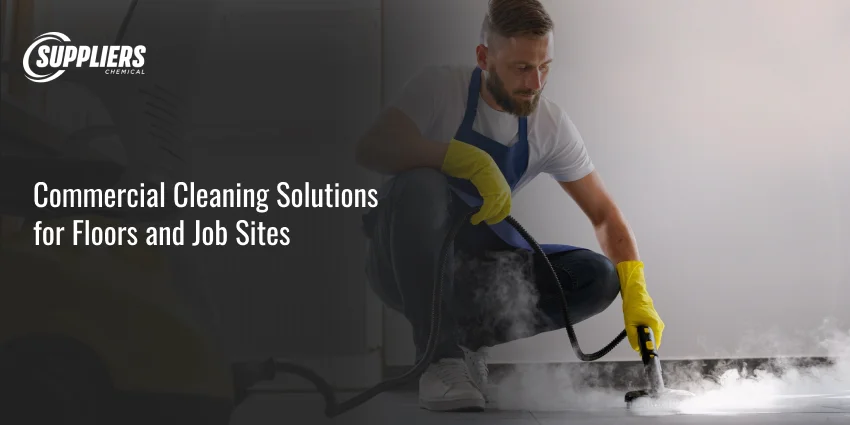
Key Takeaways
- Standard soaps spread industrial grime rather than dissolving it because they lack the surfactant concentration to break molecular bonds.
- Floor substrate determines cleaner selection: sealed concrete, polished concrete, VCT tile, and epoxy each require different pH ranges.
- Acid-based construction site cleaners dissolve calcium-based concrete and mineral deposits that alkaline floor products cannot remove at any dilution.
- Concentrated formulas at a 1:64 ratio produce 64 gallons of active solution from one gallon, reducing cost per square foot significantly.
- Suppliers Chemical provides on-site assessments to match the right products to each zone across single-site and multi-site facility operations.
Warehouses, distribution centers, manufacturing floors, and construction sites all share one problem. Standard cleaning products from retail shelves were not designed for the contaminants these environments produce.
Concrete dust, hydraulic fluid, tire marks, and food-grade residue demand more than general-purpose soap. These contaminants bond to surfaces at a molecular level and resist conventional scrubbing methods.
Professional-grade concentrated formulas engineered for specific soil types cut through industrial grime in a single pass. They reduce labor hours and extend the life of flooring surfaces that take daily abuse from heavy equipment and foot traffic.
Why Does Chemical Cleaning Outperform General Purpose Soap?
Chemical cleaning uses targeted surfactant chemistry to break molecular bonds between contaminants and surfaces. General-purpose soaps rely on physical agitation and diluted cleaning agents that spread grime around instead of lifting it off.
The difference shows up fastest on industrial floors. A warehouse floor coated in tire marks, hydraulic drips, and packaging residue requires commercial cleaning solutions built for those soil types.
Retail soap cannot penetrate heavy petroleum-based grime that bonds to concrete, epoxy, and sealed surfaces. Only engineered surfactant formulas break those molecular bonds on the first pass without damaging the substrate.
“Clients increasingly expect real-time visibility into cleaning operations,” says Kristina Thayer, Director of Business Development at MSNW Group. (Source)
That expectation for accountability extends to product performance. Facility managers need industrial-grade products that deliver consistent, measurable results across every shift and every surface type.
Concentrated industrial formulas meet that standard because they are engineered for repeatability at documented dilution ratios. The International Sanitary Supply Association reports persistent labor shortages in commercial cleaning.
Better chemistry compensates by reducing the manual effort each task requires. Smaller crews cover more square footage in less time when the formulas do the heavy lifting at the molecular level for them.
How to Pick a Commercial Floor Cleaner for Heavy Traffic
Choosing a commercial floor cleaner starts with identifying your floor substrate. Sealed concrete, polished concrete, VCT tile, epoxy-coated floors, and bare concrete each respond differently to pH levels and surfactant types.
Sealed and polished concrete floors need a mildly alkaline cleaner that lifts soil without stripping sealant. The Floor Cleaner from Suppliers Chemical handles daily use on these surfaces.
Bare concrete in warehouses and loading docks tolerates stronger alkaline cleaners. A purple degreaser at a heavier dilution ratio breaks down petroleum-based soils effectively.
Traffic patterns matter just as much as floor type. High-traffic aisles near loading docks need more frequent attention and a stronger dilution ratio than storage areas that see minimal daily activity.
A tiered cleaning schedule prevents over-cleaning in areas that do not need it. Documenting frequency by zone helps crews prioritize without guessing which areas need the most product during each cleaning shift.
|
Need Help Choosing the Right Floor Cleaner? Our team matches products to your floor type, soil conditions, and facility size. |
Construction Site Cleaners That Handle Concrete and Dust
Construction sites generate contaminants that standard products cannot dissolve. Portland cement residue, concrete splatter, grout haze, and mineral scale bond chemically to surfaces and harden over time.
These products use controlled acid formulations that dissolve calcium-based deposits without damaging the substrate. Concrete Remover breaks down hardened cement splatter on equipment.
Timing matters on construction projects. Fresh concrete splatter comes off with an alkaline wash. Once it cures past 24 hours, a dedicated concrete dissolution product is the only option.
Mechanical abrasion damages the substrate underneath. Acid-based formulations avoid that damage by dissolving the mineral bonds rather than scraping through them, which preserves the finished surface below.
Dust control is the other half of construction cleanup. Fine silica dust from cutting, grinding, and mixing operations settles on every surface and infiltrates HVAC systems throughout the entire building.
An enzyme-based floor cleaner captures fine particulates during wet mopping rather than redistributing them into the air, which protects indoor air quality during occupancy.
“ISSA’s support for the Essential Workers for Economic Advancement Act is grounded in recognition that cleaning industry employers struggle to hire enough workers, which limits their ability to meet growing demand, maintain cleanliness and sanitation standards, and protect public health,” says John Nothdurft, Director of Government Affairs at ISSA. (Source)
Read More About Construction Site Cleaners for Concrete and Grime
When job site cleaners and professional-grade products come from the same supplier, facility teams standardize training and dilution protocols across both construction cleanup and ongoing maintenance.
What Should You Look for in a Commercial Cleaning Product?
Concentration level is the first metric that separates professional-grade products from retail alternatives. A concentrated product at 1:64 produces 64 gallons of ready-to-use solution from a single gallon.
That ratio means lower shipping costs, less storage space, and fewer reorders. Facilities that switch from ready-to-use products to concentrates typically cut their chemical spend by more than half in the first quarter.
Surface compatibility is the second filter. A product safe for polished concrete may etch bare aluminum. One formulated for kitchen tile may leave residue on warehouse epoxy. Check pH range and surfactant type against your surfaces.
Professional-grade products should list dilution ratios for different soil levels on the label. Light soil might call for 1:128 while heavy grease requires 1:32. Single-ratio products force you to over-clean light soils or under-clean heavy ones.
Suppliers Chemical brings 45 years of experience to every product. Their team runs on-site assessments to match the right chemistry to each zone of your facility.
Read More About Freezer Cleaners for Foodservice Operations
Concentrated Chemical Formulas That Cut Cost per Square Foot
Cost per square foot is the metric that separates cleaning budgets from cleaning investments. A commercial floor cleaner that produces 128 gallons of solution per gallon of concentrate costs pennies per application.
Even on a 50,000 square foot warehouse floor, the per-use cost stays low enough to justify daily cleaning schedules. That math changes the conversation from expense to investment for facility managers.
Ready-to-use products hide their true cost behind a lower sticker price. A gallon of pre-mixed cleaner covers one application on a limited area, while a concentrated formula covers dozens.
Job site cleanup follows the same math. A concentrated degreaser at heavy dilution handles post-construction grease, while lighter dilution maintains floors during the occupancy phase.
“Autonomous vacuums and scrubbers are becoming common in large, open spaces. They don’t replace staff but handle repetitive work, letting employees focus on detail cleaning or filling in for absenteeism,” says Charles Keenum, Senior Vice President at The Budd Group. (Source)
Pairing concentrated products with automated equipment multiplies the savings. Scrubber machines calibrated to dispense exact dilution ratios eliminate product waste and deliver consistent results across every pass.
|
Want to Lower Your Cleaning Cost per Square Foot? We help facilities calculate exact product needs based on floor area and soil type. |
Building a Cleaning Supply Plan for Multi-Site Operations
Multi-site operations face a unique problem with cleaning supply chains. Each location may have different floor types, soil conditions, and crew sizes, which makes standardization across sites essential for results.
Every site ordering different products and training differently leads to inconsistent outcomes. A unified industrial cleaning program solves that problem by bringing every location onto the same product platform.
Start by auditing each location for floor substrate, primary contaminants, and square footage. A warehouse with sealed concrete and forklift traffic needs a different product than a retail space with VCT tile and foot traffic.
Standardize on a single supplier that covers your full product range. When your commercial cleaning solutions come from one manufacturer, ordering and inventory management are simplified dramatically.
Create a product matrix that maps each product to each location based on the audit results. Document dilution ratios, application methods, and cleaning frequency for every product and surface combination in your operation.
This matrix becomes your training document for new hires at any site. Consistent protocols across locations mean every crew delivers the same results regardless of which facility they work in each week.
Suppliers Chemical supports multi-site operations with bulk ordering and custom consulting. Their team reviews facility needs and builds product recommendations for each location in your portfolio.
|
Managing Cleaning Across Multiple Facilities? Our team builds custom product plans for multi-site operations of every size. |
Conclusion
The right commercial cleaning solutions turn floor maintenance from a recurring headache into a predictable, cost-effective operation. Matched formulas deliver better results with less product and less labor.
Suppliers Chemical has spent 45 years building professional-grade cleaning chemistry for warehouses, construction sites, and commercial facilities across the United States, earning trust from facility managers nationwide.
If you need help choosing the right products for your floors and job sites, get in touch with the team today to discuss your facility needs and get a product recommendation.
FAQs

Recommended articles
Commercial Floor Cleaner Guide: Pharma and Food Processing Facilities
Pharmaceutical and food processing facilities require commercial floor cleaners that pass regulatory scrutiny, leave no harmful residue on food-contact zone surfaces, and are validated or documented for compliance with FDA cGMP and HACCP standards. A commercial cleaning solution that works in a warehouse may fail a pharmaceutical audit if it isn’t compatible with cleanroom classification…
Fleet Cleaning Solutions: EPA Stormwater Rules & Compliant Chemicals
Fleet cleaning operations that discharge wastewater to storm drains, ditches, or surface water without an NPDES permit violate the Clean Water Act. Compliant fleet cleaning solutions use biodegradable formulas, and all wash runoff must either drain to the sanitary sewer with pretreatment approval or be collected through a closed-loop water recycling system. Most fleet managers…
What Fleet Cleaning Solutions Actually Cut Wash Time Without Damaging Vehicle Finishes?
Concentrated fleet cleaning solutions cut wash time by eliminating the repeat passes that general-purpose soaps require. High-foaming formulas applied with pressure washers or foam cannons penetrate road film, diesel soot, and bug residue in one pass without physical scrubbing, protecting clear coats, aluminum panels, and vinyl graphics while reducing labor time per vehicle. Key Takeaways…