
Commercial Floor Cleaner Guide: Pharma and Food Processing Facilities
Pharmaceutical and food processing facilities require commercial floor cleaners that pass regulatory scrutiny, leave no harmful residue on food-contact zone surfaces, and are validated or documented for compliance with FDA cGMP and HACCP standards. A commercial cleaning solution that works in a warehouse may fail a pharmaceutical audit if it isn’t compatible with cleanroom classification requirements or documented in the facility’s cleaning validation plan.
Floor cleaning in regulated manufacturing environments isn’t just about appearance. It’s a documented, validated process that sits directly in the path of FDA inspections, HACCP audits, and food safety certification reviews. The wrong commercial cleaning solution can leave residue that causes cross-contamination, alter surface pH in zones with strict control requirements, or simply fail to appear in a facility’s cleaning validation documentation.
Industrial floor cleaning for pharmaceutical and food processing facilities has become more complex in 2025-2026 as regulatory agencies tighten expectations for validation documentation of commercial cleaning solutions under FDA 21 CFR Parts 210-211 for pharma and FSMA (Food Safety Modernization Act) requirements for food manufacturers.
Key Takeaways
- FDA cGMP regulations under 21 CFR Parts 210-211 require written cleaning procedures, validated cleaning methods, and documented residue limits for pharmaceutical manufacturing floors
- HACCP programs in food processing facilities must address non-food-contact surfaces, including floors, drains, and conveyor undersides as potential contamination sources
- The correct floor cleaner for a pharmaceutical cleanroom is a different chemistry profile than what works in a food processing wet zone or a construction site
- Chemical cleaning selection must account for substrate compatibility with 304/316 stainless, PVC, epoxy-coated concrete, and tile surfaces
- Construction site cleaners face different requirements than food or pharma floors but must address concrete, cement, and heavy contamination without generating regulated waste streams
- Suppliers Chemical recommends matching cleaning chemistry to zone type rather than using a single all-facility product
Why Standard Floor Cleaners Fail Regulated Environments
The FDA’s current Good Manufacturing Practice regulations, specifically 21 CFR Part 211.67, require that equipment and utensils, including facility surfaces in contact with drug products or ingredients, must be cleaned and maintained to prevent contamination. The regulation requires written procedures detailing cleaning schedules, methods, cleaning agents, and validation that procedures are effective.
A 2025 cGMP compliance analysis by Summit Janitorial found that FDA facility inspections routinely flag inadequate cleaning procedures and a lack of cleaning agent documentation as deficiencies. Standard floor cleaners often fail not because their chemistry is harmful, but because they lack the SDS documentation, validated residue limits, and substrate compatibility data that regulated facility audits require.
“Cleaning validation in pharmaceutical manufacturing is fundamentally about proof. You need documented evidence that your cleaning process reduces residues to acceptable levels, and that includes the commercial cleaning you’re using at defined concentrations and contact times.” – Dr. Bhavesh Patel, Senior Consultant, Center for Professional Innovation and Education, CFPIE Cleaning Validation Guidelines
Food processing facilities face a parallel requirement under HACCP. HACCP plans must identify all biological, chemical, and physical hazards at each step in the process, including the cleaning steps themselves. A floor cleaner that leaves surfactant residue in floor drains adjacent to food production zones represents a chemical hazard that must be managed and documented in the HACCP plan.
The practical implication is that the floor cleaner you choose needs to be one you can document fully: its active ingredients, validated use concentration, contact time, rinse requirements, and residue profile on the specific surface types in your facility.
Read More About: Industrial Floor Cleaners to Cut Downtime and Boost Workplace Safety
What Do FDA cGMP Rules Require for Pharmaceutical Floors?
Under FDA 21 CFR Part 211.28, manufacturing personnel must wear clean clothing appropriate for duties performed, and production areas must be maintained in a clean and sanitary condition. Floors are specifically addressed in FDA guidance as a primary source of particulate and microbial contamination in pharmaceutical environments.
FDA cGMP requirements for pharmaceutical floor cleaning include:
- Written standard operating procedures (SOPs) for all cleaning activities, including frequency, chemical identity, dilution rate, and contact time
- Validation data demonstrating that the cleaning procedure removes product residues to below acceptable limits (typically 1/1000th of the therapeutic dose for APIs)
- Substrate compatibility confirmation for the floor surface material, whether epoxy-coated concrete, ceramic tile, or specialty cleanroom flooring
- Operator training documentation for all personnel performing cleaning activities
- Batch records or cleaning logs for every cleaning event in controlled manufacturing areas
The chemical cleaning agents used in pharmaceutical environments must be selected for residue profile, not just cleaning performance. An alkaline degreaser that leaves a film on epoxy-coated concrete fails FDA compliance requirements if the film can transfer to product or equipment contact surfaces. The choice of commercial cleaning solutions for these environments requires reviewing the full SDS, the rinse requirement profile, and the substrate compatibility matrix before purchase.
For Class ISO 7-8 cleanrooms, which are the most common pharmaceutical manufacturing classifications, the cleaning validation expectation involves demonstrating that the floor cleaner, when applied per the SOP, reduces surface contamination to specified limits and that the rinse process removes the cleaning agent to below detectable levels.
|
Need Cleaning Solutions Matched to Your Industry? Suppliers Chemical works with food processing, pharmaceutical, and industrial facility managers to identify compliant cleaning solutions with full SDS documentation. Our team reviews your zone map and recommends products matched to your regulatory requirements. |
How Do HACCP Standards Drive Floor Cleaning in Food Plants?
HACCP (Hazard Analysis and Critical Control Points) requires food processing facilities to identify and control every point where contamination could enter the food production stream. Floors and drains in food processing wet zones are classified as non-food-contact surfaces but are still subject to cleaning frequency requirements because they are sources of biological and chemical hazards.
FDA’s Food Safety Modernization Act (FSMA) regulations under 21 CFR Part 117 require that all food manufacturing facilities implement and document preventive controls, including cleaning and sanitation procedures. Non-food-contact surfaces must be cleaned as frequently as necessary to prevent contamination of food, food-contact surfaces, and food-packaging materials.
“Selecting the wrong floor cleaner for a food processing environment doesn’t just create a compliance gap. It creates a direct contamination pathway. Every surfactant that isn’t fully rinsed from a floor drain becomes a potential chemical adulterant for the next product batch.” – Sandra Hoffmann, Food Safety Economist, FDA Food Safety Modernization Act Program
Specific HACCP-driven requirements for floor cleaners in food processing include:
- Approved chemical list: All cleaning chemicals must appear on the facility’s approved chemical list with documented safety data and use procedures
- Residue limits: Rinse requirements must be validated to remove cleaning agent residues below the levels established in the facility’s preventive controls plan
- Drain management: Floor drains in wet processing zones are classified as critical points for pathogen harborage and require regular deep cleaning with chemical cleaning agents specifically evaluated for drain biofilm control
- Zone separation: Cleaning solutions used in raw product zones must be distinct from those used in ready-to-eat zones to prevent cross-contamination via cleaning equipment or personnel movement
- Documentation of each cleaning event: HACCP records must include the cleaning agent used, concentration, contact time, and the personnel who performed the cleaning
The standard floor cleaner selected for a food processing facility must be NSF-registered or equivalently documented for food-zone use if it could contact food-contact surfaces. For floor areas that are indirect risk zones, the documentation requirement is less strict but still requires SDS documentation and inclusion in the HACCP chemical inventory.
Read More About: Construction Site Cleaners: Effective Solutions for Concrete and Grime
Choosing Cleaning Solutions by Industry Zone
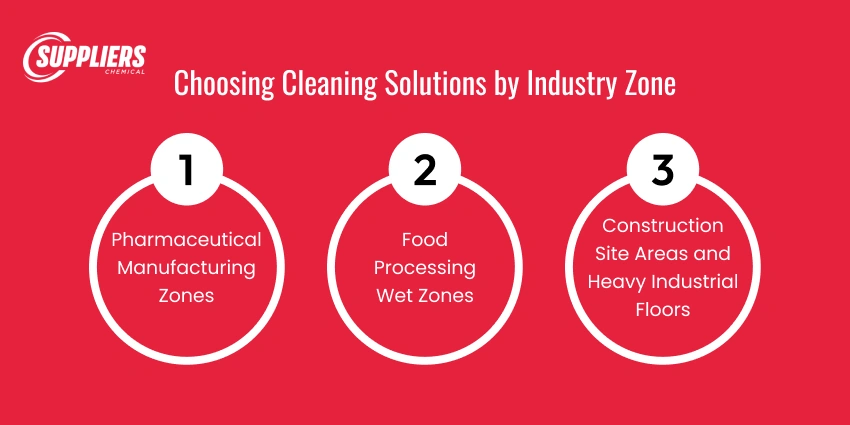
Not all areas of a facility have the same requirements, and a single floor cleaner product rarely serves every zone optimally. Zone-based selection matches cleaning chemistry to the specific contamination type, substrate, and regulatory requirement of each area.
Pharmaceutical Manufacturing Zones
Pharmaceutical manufacturing areas require low-residue, low-foaming cleaning solutions with validated rinse profiles. Quaternary ammonium compounds work well for combined cleaning and sanitizing in controlled environments. Enzymatic cleaners are preferred for organic residue removal in API manufacturing areas because they break down residues rather than displacing them.
Avoid surfactant-heavy formulas with high foam generation in cleanroom environments. Foam residue in floor joints and wall-floor coves is a regulatory deficiency that auditors flag consistently.
Food Processing Wet Zones
Food processing wet zones require floor cleaners with strong biofilm penetration and documented NSF registration. Alkaline foam cleaners are the standard approach for walls and floors in wet processing environments because the foam increases contact time on vertical and angled surfaces. Follow alkaline foam cleaning with an acid rinse to neutralize pH and remove mineral deposits from hard water.
For drain cleaning specifically, chemical cleaning with a dedicated drain maintenance product controls the biofilm accumulation in drain bodies that standard floor cleaning doesn’t reach.
Construction Site Areas and Heavy Industrial Floors
Construction site cleaners face a fundamentally different set of requirements than food or pharmaceutical floors. The primary contamination types on construction site floors include Portland cement, concrete spatter, heavy oil, and grease from equipment, paint, and general site dust.
Acid-based commercial cleaning handles concrete and cement residue effectively but requires careful management on metal surfaces and drainage systems. Heavy-duty alkaline degreasers address petroleum contamination on concrete floors before acid treatment. For construction site environments, the goal is contamination removal efficiency rather than regulated residue compliance, though proper chemical waste management still applies.
Suppliers Chemical’s cleaning solutions include dedicated products for each of these zone types, formulated specifically for the contamination profile and surface compatibility requirements of each environment.
Read More About: How Do Commercial Fleet Cleaning Solutions Protect Vehicle Lifespan?
What About Construction Sites and Heavy Industrial Floors?
Construction sites present a different set of floor cleaning challenges than food or pharmaceutical environments. The regulatory concern isn’t product contamination; it’s worker safety, equipment preservation, and wastewater management.
Heavy industrial and construction floor cleaning typically addresses:
- Concrete and cement residue: Fresh concrete spatter left on equipment pads or floor surfaces hardens and requires acid cleaning or mechanical removal; catching concrete residue while it’s still workable reduces cleaning effort significantly
- Oil and grease contamination: Equipment service areas and fuel dispensing zones accumulate petroleum contamination that requires concentrated heavy-duty degreaser at appropriate dilution before disposal via oil-water separator
- Silica dust and fine particulates: Construction site floors with silica-containing materials (concrete, masonry) generate respirable silica dust; wet cleaning methods with industrial floor cleaning solutions are preferred over dry sweeping to prevent airborne dust generation
- Paint and coating residue: Wet paint and coating spatter cleans differently than cured residue; selecting the appropriate chemistry requires knowing the coating type (water-based, oil-based, epoxy) before choosing the cleaner
For construction sites, the primary documentation requirement is maintaining Safety Data Sheets on file for any chemical cleaning agents used on site, as required by OSHA’s Hazard Communication Standard (29 CFR 1910.1200). This is a significantly lower bar than pharmaceutical or food processing compliance, but it’s still a defined requirement that construction site managers need to meet.
|
Professional-Grade Cleaning Chemistry for Every Industrial Environment Suppliers Chemical offers 40+ years of formulation expertise across foodservice, pharmaceutical, construction, and industrial cleaning applications. Every product comes with full SDS documentation and application support. |
How to Build a Compliant Floor Cleaning Protocol
Step 1: Map Your Facility Zones by Regulatory Category
Walk your facility and categorize each area by its regulatory classification: pharmaceutical controlled area, food processing wet zone, food processing dry zone, warehouse, construction work area, or general industrial. This zone map becomes the foundation of your cleaning protocol and determines which cleaning solutions are appropriate for each area.
Step 2: Match Cleaning Solutions to Each Zone
For each zone on your map, select a floor cleaner that matches the contamination type, substrate material, and regulatory requirement. Pharmaceutical controlled areas need low-residue, validated chemistries. Food wet zones need NSF-registered alkaline cleaners. Heavy industrial areas need concentrated degreasers. Document the specific product, dilution rate, and application method for each zone.
Step 3: Define Cleaning Frequencies by Zone and Activity
Cleaning frequency requirements differ by zone. Food processing wet zones may require cleaning between every production shift. Pharmaceutical manufacturing areas require cleaning after each batch or at defined intervals in the SOP. Warehouse and industrial areas typically operate on daily or weekly schedules. Build a frequency matrix that accounts for production schedules, soil load, and regulatory requirements.
Step 4: Write and Validate Your Cleaning Procedures
For regulated environments, written procedures are mandatory, not optional. Your SOPs must include the specific floor cleaner product name and lot traceability, dilution rate, application method, contact time, rinse procedure, and documentation requirements for each cleaning event. For pharmaceutical environments, cleaning procedures require validation studies that demonstrate the procedure achieves residue levels below acceptance criteria.
Step 5: Train Staff and Maintain Chemical Records
All personnel performing regulated cleaning activities must be trained on the written procedures and demonstrate competency. Training records must be maintained and available for regulatory inspection. Keep an updated chemical inventory with SDS for every commercial cleaning solution in use, and conduct annual reviews to ensure the chemical inventory and procedures remain current with any facility changes or regulatory updates.
Conclusion
Selecting the right floor cleaner from for a pharmaceutical or food processing facility isn’t a purchasing decision you make based on price per gallon. It’s a compliance decision that affects your audit readiness, your product quality risk, and your ability to document the regulatory requirements your customers and inspectors expect to see.
The chemistry that works for a construction site floor doesn’t meet the residue and documentation requirements of a pharmaceutical cleanroom. The degreaser that clears oil from an industrial floor may carry pH and surfactant concentrations that violate your food plant’s HACCP plan. Matching commercial cleaning solutions to the specific zone type, substrate, and regulatory framework is the foundation of a compliant and effective chemical program.
Suppliers Chemical is here to discuss your facility’s zone map. Contact us to find the commercial floor cleaner formulas that meet your regulatory and performance requirements.
FAQs

Recommended articles
Fleet Cleaning Solutions: EPA Stormwater Rules & Compliant Chemicals
Fleet cleaning operations that discharge wastewater to storm drains, ditches, or surface water without an NPDES permit violate the Clean Water Act. Compliant fleet cleaning solutions use biodegradable formulas, and all wash runoff must either drain to the sanitary sewer with pretreatment approval or be collected through a closed-loop water recycling system. Most fleet managers…
Why Do Warehouses and Construction Sites Need Specialized Commercial Cleaning Solutions?
Commercial cleaning solutions for warehouses, distribution centers, and construction sites use engineered surfactant chemistry to break molecular bonds between contaminants and surfaces. Standard retail soaps cannot dissolve petroleum-based grease, concrete dust, hydraulic fluid, or tire marks that bond to industrial floors. Concentrated professional formulas address specific soil types in a single pass, reducing labor hours…
What Fleet Cleaning Solutions Actually Cut Wash Time Without Damaging Vehicle Finishes?
Concentrated fleet cleaning solutions cut wash time by eliminating the repeat passes that general-purpose soaps require. High-foaming formulas applied with pressure washers or foam cannons penetrate road film, diesel soot, and bug residue in one pass without physical scrubbing, protecting clear coats, aluminum panels, and vinyl graphics while reducing labor time per vehicle. Key Takeaways…